An app that reads medicine boxes aloud
A blind or low-vision person holds their phone up to a medicine box. İlaçSes says the drug's name, its active ingredient and the expiry date.
Recognises the 23,041 medicines on Türkiye's official drug list. Works offline, no account needed.
The information on the box is printed for the eye
The expiry date is a line of small print on the edge of the box, and two boxes of the same size feel identical in the hand. A blind person usually has to wait for someone else to read them.
- 2.2 billion
- People worldwide with near or distance vision impairment, at minimum. [1]
- Over 50
- The age group most people with vision impairment and blindness belong to. It's also the group that takes the most medicine. [2]
- 281,439
- People registered as visually impaired in Türkiye's National Disability Data System. [3]
Hear it for yourself
Pick a box. A sample barcode stands in for the camera; everything after that is the app's real code. In this demo the cabinet already holds two medicines: a blood pressure pill that's due right now, and a paracetamol. The app speaks Turkish, so an English summary appears under the result.
Pick a boxThe result also appears here as text.
Three steps to identify a medicine
No need to look at the screen. The app guides you with speech, beeps and vibration. The 34-second recording is the app itself, running on a prepared image of a box instead of a live camera. Everything the app says is in the captions (English, or the original Turkish).
-
Show the box to the camera
Once the barcode comes into view the app starts beeping, faster as the code nears the centre. In between it says things like "move the phone to the left" or "bring it closer".
-
Listen to the result
Name, active ingredient and expiry date are read out. If the box has expired, an alarm sounds and that warning comes before anything else.
-
Set up your medicine cabinet
Add your own medicines once (a relative can do it too). After that the app also tells you whether you've taken today's dose and whether the box is actually yours.
Transcript: what the app says and what happens on screen
- 0:00 On screen: The home screen. Under today's doses, "My blood pressure pills" is marked as due.
- 0:02 On screen: The "Kutuyu okut" (Scan the box) button is pressed and the camera opens.
- 0:03 App: “Camera on.”
- 0:03 On screen: The camera shows the back of the box, with no code in view.
- 0:05 App: “I can't see a code. Turn the box slowly and try another side.”
- 0:08 On screen: The box is turned. The code appears on the left of the picture, blurred.
- 0:10 App: “Move the phone a little to the left.”
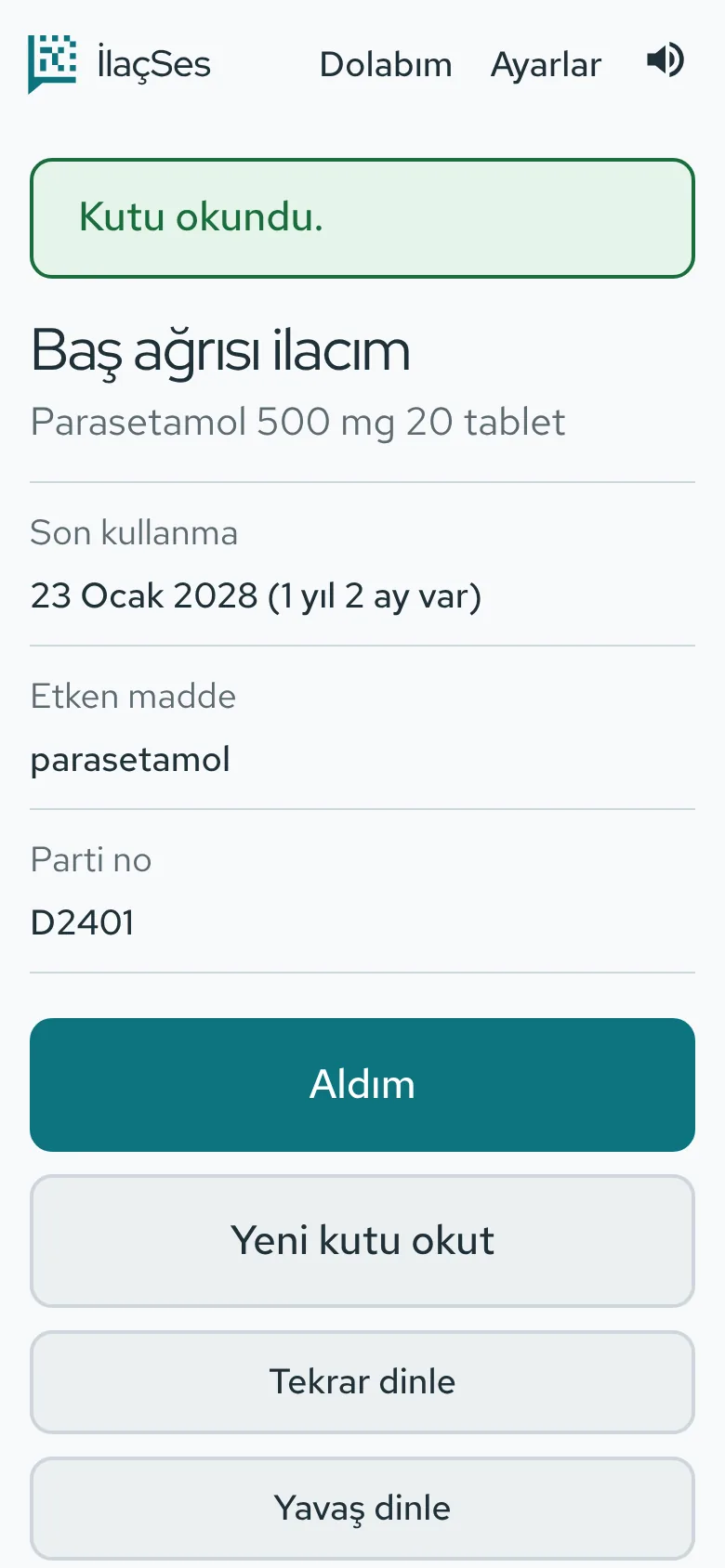
- 0:13 On screen: The code reaches the centre and is read. The result screen shows a green "dose due" banner, the drug name, expiry date and active ingredient.
- 0:13 App: “My blood pressure pills. Cromtol 5 milligram tablets, 28 tablets. Active ingredient: nebivolol hydrochloride. Expiry date 30 April 2028. 1 year 5 months left. Midday dose is due, 14:50. You haven't taken it yet. Press "Aldım" (Taken) once you take it.”
- 0:25 On screen: "Aldım" (Taken) is pressed. The banner changes to "Saved as taken".
- 0:25 App: “Saved: my blood pressure pills, 14:51.”
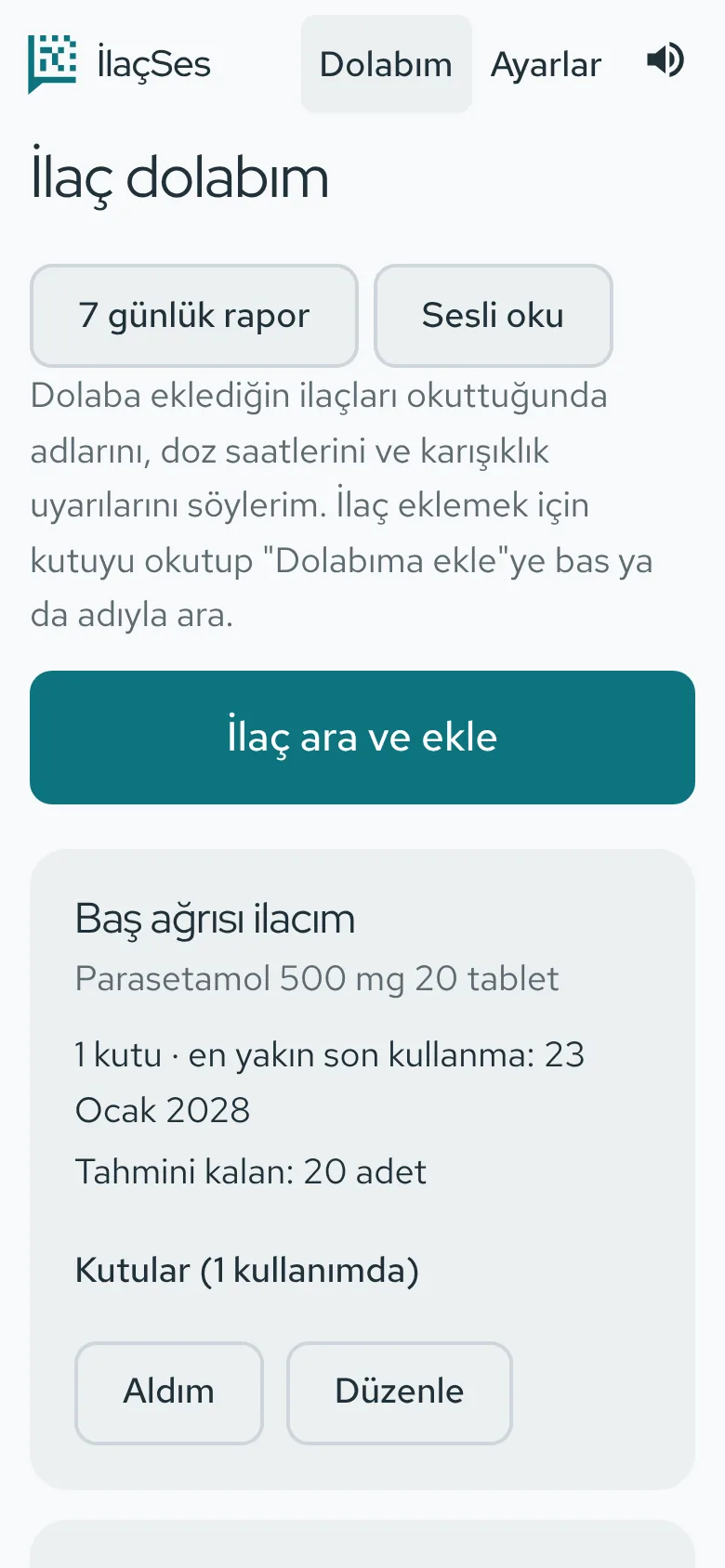
- 0:30 On screen: "Dolabım" (My cabinet) opens. The medicine's card shows its dose time and when it was last taken.
It reads the barcode, not the print
Since 2010, every medicine box sold in Türkiye carries a 2D barcode from the national Drug Tracking System [4]. Reading printed text from a photo can go wrong on a crumpled box or in bad light. The barcode has error correction, and the product number has a check digit: a misread code is rejected, so the user is never told a wrong date.
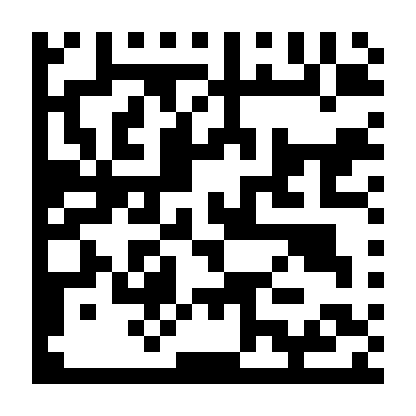
| Field | In the code | What the app says |
|---|---|---|
| (01) | 08699536011097 | Cromtol 5 mg tablets, 28 tablets. Active ingredient: nebivolol hydrochloride |
| (17) | 280430 | Expiry date 30 April 2028 |
| (10) | T2611 | Batch number |
| (21) | TESTK7Q2M9 | Serial number, so the same box is never counted twice |
The sample code was made for testing. The product number belongs to a real medicine on the official list; the serial, batch and date are made up.
What it tells you
It does more than read the box. It checks the box against the medicines in your cabinet and puts anything that could cause a mix-up first.
Safety
- Alarm if the box has expired
- Warning if another medicine in your cabinet has the same active ingredient
- Warning if you took the same medicine a short while ago
- "This may not be yours" if the box isn't in your cabinet
- Use-by period after opening, for eye drops and syrups
Everyday use
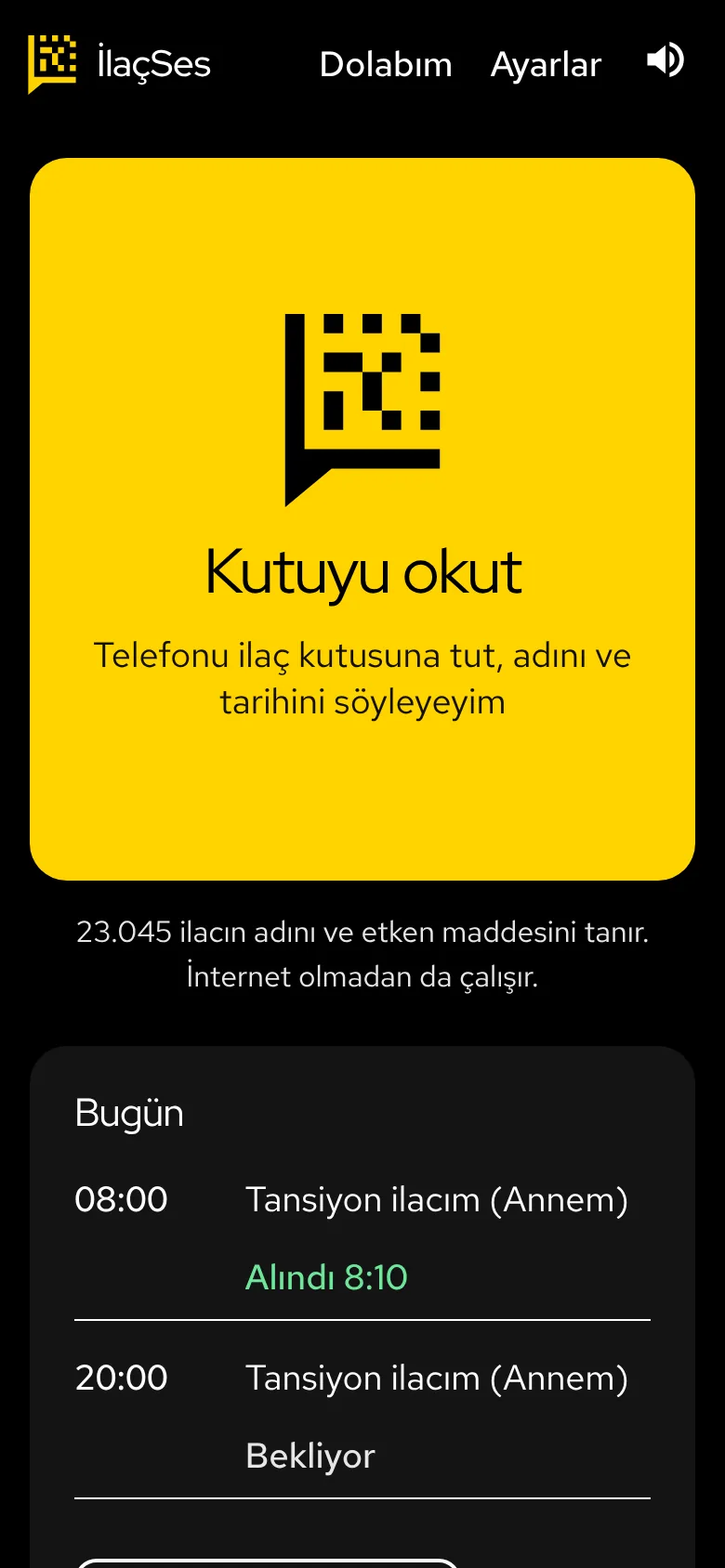
- Today's doses, read aloud
- Daily repeating reminders in your phone's calendar
- Which box to use first when you have several
- A heads-up to renew the prescription before you run out
- A 7-day dose report you can send to your doctor
- Search by name to add a medicine without the box
Accessibility
- Works with TalkBack and VoiceOver
- Vibration patterns and vibration guidance
- Voice commands: "taken", "repeat", "slower", "next"
- Without a screen reader too: each screen is described aloud, and tapping a button says its name
- Picks the most fluent Turkish voice on the phone; speech can be stopped
- Yellow-on-black high contrast theme
- Three text sizes
- Says whose medicine it is when several people share a cabinet
Under the hood
Everything runs in the phone's browser. There is no server: neither the camera feed nor the medicine cabinet ever leaves the phone.
- CameraAbout 10 frames a second are downscaled and inspected.
- Code finderSpots the barcode by its solid "L" border and turns its position into spoken directions and beeps.
- Decoderzxing-wasm in a separate worker thread; the area around the code is cropped at full resolution.
- GS1 parsingSplits out product number, date, batch and serial; a read with a bad check digit is dropped.
- Drug list and cabinetThe 23,041-item official list lives on the phone and is compared with your cabinet and dose log.
- DecisionWarnings are ranked: expired, double dose, same ingredient, then name and date.
- Speech, vibration, screen readerAbbreviations become natural Turkish: "500 MG 20 FTB" is read as "500 milligrams, 20 film-coated tablets".
Measured so far
- ~1 MB compressed download including the drug list; after that it works offline
- 12/12 synthetic box images where the code finder located the code, with no false alarm on a code-free image
- 34 unit tests and 107 end-to-end checks, with an automated accessibility scan on every screen
- ~30 ms to decode one frame (test computer, real Chrome)
Testing on real phones and with blind users is under way. This section will be updated as results come in.
Installing it on a phone
No app store needed. It opens in the phone's browser and behaves like an app once added to the home screen.
Android
Open it in Chrome and choose "Add to Home screen" from the menu.
iPhone
Open it in Safari and choose "Add to Home Screen" from the Share button.

On a computer? Scan this with your phone's camera.
Your data stays on the phone
The medicine cabinet, dose log and settings are stored only on the phone. There's no account and nothing is sent to a server. Drug names come from the public Licensed Human Medicinal Products List of TİTCK, Türkiye's medicines agency (27 November 2026) [5].
İlaçSes does not recommend doses. Doctors and pharmacists decide how much and when; the app only reads what's on the box and the times the user entered.
Accessibility
The app and this site were checked against all 50 WCAG 2.1 AA success criteria, one by one: 41 pass, 6 don't apply, and 3 stay open until they are verified with TalkBack and VoiceOver on real phones. Every release runs an automated audit of every screen in both themes, on a narrow screen and in landscape. Full conformance report (in Turkish)
A barcode that talks
The logo is drawn from the structure of a real DataMatrix code: the solid line on the left and bottom edges, the dashed timing line along the top and right. The app's code finder recognises barcodes by those same lines. The tail in the bottom-left corner turns the code into a speech bubble.
It comes in three versions: the teal app icon, a yellow-and-black icon for the high contrast theme, and a single-colour mark.


What's next
What the app does today, what's being worked on, and what comes after. Feedback from user testing may change the order.
Done
- Reading the 2D code and the barcode, with spoken directions
- The 23,041-drug TİTCK list, offline
- Medicine cabinet, dose times, 7-day report
- Screen-reader mode, voice commands, vibration patterns
- Spoken navigation without a screen reader: screen descriptions, tap to hear
- Step-by-step help when camera access is blocked, reading from a photo
In progress
- Testing with real boxes on Android phones and iPhones
- Testing and interviews with blind users
- Rewording the spoken directions based on test results
Planned
- Weekly automatic updates of the TİTCK list
- Letting a relative know when a dose is missed (only if the user wants it)
- Publishing on Google Play
- Reading the key sections of the package leaflet aloud
For judges and press
A short description, a one-page project summary, the video, the logo and screenshots. Feel free to use them when writing about the project. The summary and screenshots are in Turkish.
İlaçSes is a web app that reads medicine boxes aloud for blind and low-vision people. Point the phone at a box and it reads the Drug Tracking System code, then says the drug's name, active ingredient and expiry date in Turkish. If the box has expired, the dose was just taken, or another medicine in the cabinet has the same ingredient, it says that first. It knows 23,041 drugs, works offline and keeps all data on the phone.
Questions
Does it need the internet?
Only the first time. The app and the drug list are saved on the phone and then work offline. A few features, such as voice commands and calendar reminders, need a connection.
Which phones does it run on?
Android phones with a recent Chrome, and iPhones with Safari. The camera needs the page to be served over https, which the published address is.
Does it work with a screen reader?
Yes. On first launch it asks whether you use TalkBack or VoiceOver. If you do, the app mutes its own voice and sends every message to your screen reader, so you never hear the same sentence twice.
What if it can't find the code?
It tells you to turn the box slowly and try another side. After a few tries it reminds you that on most boxes the code sits on one of the narrow sides. It also reads the ordinary barcode, but that one has no date. If it sees no code at all for two minutes, it turns the camera off to save battery.
What language does it speak?
Turkish. It is built for medicine boxes sold in Türkiye, whose barcodes and official drug list it reads.
How current is the drug list?
TİTCK publishes the list every week. The version in the app is dated 27 November 2026, and phones pick up a newer list automatically the next time the app opens.
Does it recommend doses?
No. It only reads what's on the box and the dose times you entered. Your doctor and pharmacist decide how much and when.
Is it free?
Yes, and there are no ads.